
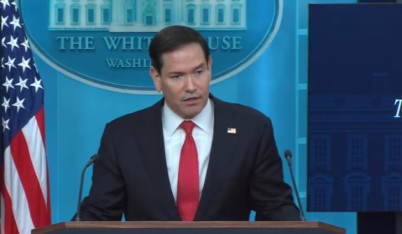
ROME — U.S. Secretary of State Marco Rubio met with Pope Leo XIV on Thursday as relations between the Vatican and the White House remain strained following President Donald Trump’s repeated criticism of the American-born pontiff. Pope Leo has become one of the world’s most outspoken critics of the war in Iran and of the administration’s use of religious rhetoric to justify military action that has caused thousands of deaths.
The dispute has created an unusually sharp divide between the United States and the leadership of the Catholic Church. While both sides have tried publicly to downplay the disagreement, Vatican officials have privately expressed concern over Trump’s comments, viewing them as unusually aggressive toward a pope.
A senior Vatican official, speaking anonymously because of the sensitivity of the issue, said the current tensions are among the most serious in recent memory. “I don’t think such language has ever been directed at a pope before,” the official said, adding that although the rhetoric has intensified the conflict, both sides still have an interest in restoring dialogue.
Rubio’s visit marks a rare level of engagement between a U.S. secretary of state and the head of the Catholic Church. Rubio, who also serves as acting national security adviser and is one of the few practicing Catholics to hold America’s top diplomatic position, previously met Pope Leo shortly after his inauguration last year.
The conflict over Iran has significantly reshaped Leo’s public role. Once viewed as reserved and cautious, the pope has increasingly spoken out against war and challenged what he describes as distortions of Christian teaching used to justify violence. Vatican observers believe Leo has emerged as one of Trump’s most influential international critics, particularly because of his moral authority among Catholics worldwide.
Some conservative Catholics aligned with Trump have criticized Leo’s interpretation of Church teachings, arguing he takes an overly absolute stance against war. However, public opinion in both Europe and the United States has largely shifted against the conflict in Iran, strengthening the pope’s position.
Recent polling by The Washington Post, ABC News, and Ipsos showed Trump’s support among American Catholics has fallen significantly since the 2024 election. The same survey found broad approval for Pope Leo’s appeals for peace and rejection of war, while most respondents reacted negatively to Trump’s claim that the pope supported Iran obtaining nuclear weapons.
Vatican officials recognize that maintaining ties with American Catholics remains important, particularly because the U.S. Catholic Church contributes substantial financial support to Church operations and charitable work worldwide. At the same time, the Vatican traditionally favors diplomacy and de-escalation during political disputes.
Rubio acknowledged before the trip that tensions had risen since the meeting was arranged, though he emphasized that discussions would also focus on broader international issues, including the Middle East, religious persecution, and Cuba.
Cardinal Pietro Parolin, the Vatican’s secretary of state, indicated the recent disagreements would inevitably come up during talks. He described Trump’s attacks on the pope as “a little odd,” but suggested Pope Leo would likely welcome direct communication with Trump if requested.
Rubio’s visit to Rome also comes amid wider strains between the United States and Europe. Trump has angered several European allies over the Iran conflict, potential troop reductions in Germany, and threats of new tariffs on European cars. Italian Prime Minister Giorgia Meloni, once seen as closely aligned with Trump, has recently become more willing to criticize him, particularly over his remarks about the pope.
Italian officials reportedly see Rubio’s trip primarily as an attempt to repair relations with the Vatican, while broader concerns continue to grow in Europe over America’s long-term commitment to the continent’s security alliance.